)
Key Takeaways
US consumer confidence has fallen to new all-time lows.
Consumers still account for roughly 68% of US GDP, which means economic growth may be at risk.
Chart of the week: Market expectation of US interest rates.
Bitcoin and most major digital assets remain relatively range bound, following a bit of a sell off across the last three weeks. Many cryptocurrencies are back to circa January–February prices – except Hyperliquid.
I won’t cover why today, but if you’re interested in a look into the fundamentals of why this is bucking the broader market trend, we covered it this week in our Tapping Into Crypto podcast – go check that out on Spotify and Youtube.
Instead, this week, I want to take a step back from just digital assets and look at the overall state of macroeconomic forces. There are some reasons that I believe will help everyone understand why the road ahead is so mixed in my view.
If you missed it, Kevin Warsh has been sworn in as the 17th chairman of the US Federal Reserve and now will be a key driver in economic policy. And this matters.
Let’s dig in.
The pressure point
The setup for this article is that consumer sentiment is weakening, at a time where relief may not be around the corner.
The below chart shows consumer confidence surveys from both the US and Australia. The US is at new lows looking back over the last five years, while Australia is not too far off either. The average consumer is pessimistic about their own financial situation, and the current economic outlook.
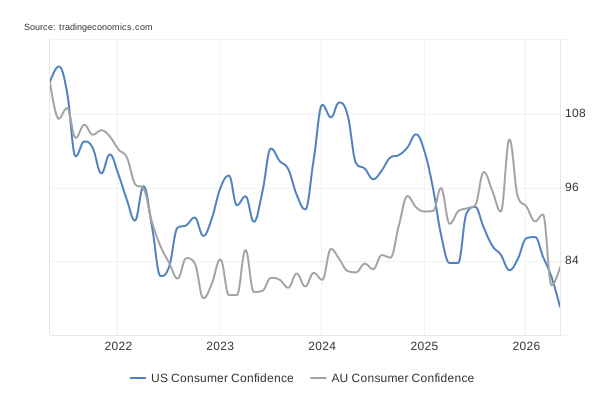
When we look at surrounding data points, inflation expectations are still elevated. The University of Michigan survey showed year-ahead inflation expectations rising to 4.8%, while longer-run inflation expectations rose to 3.9%.
That is the problem in a nutshell.
Usually, when the consumer starts to feel the pain, growth starts to soften, the markets begin looking for lower short-term rates as some sort of circuit breaker. This is because lower rates can ease pressure on households, small businesses, credit markets, and short-term liquidity conditions. And if you’re invested in markets, that is the path you may want to see – as lower rates can mean more people have more money available to invest.
But, with inflation still being a concern and the job market not showing significant stress, it becomes harder for policymakers, like the Fed, to deliver rate relief news for consumers.
And when we look ahead at the market’s expectations of interest rates, the story remains choppy.
Chart of the week: The market’s expectations of interest rates in the US
This week’s chart looks at the forward curve for 30-day Fed Funds futures. This gives us the market’s view on short-term interest rates expectations. It’s not predictive, but it gives a snapshot of how the market is positioning itself.
Below, we have what the US market is pricing in currently for interest rates. And right now, the message is clear. The market is not anticipating a clean easing cycle.
)
The current target range is 3.50% to 3.75%, and the June FOMC meeting is coming up on June 16th. Now, Kevin Warsh has also officially taken office as Fed Chair.
And that’s where things get interesting to watch in my view.
Will the new chair shake up the market’s expectations? Or confirm them?
We won’t have to wait long to find out.